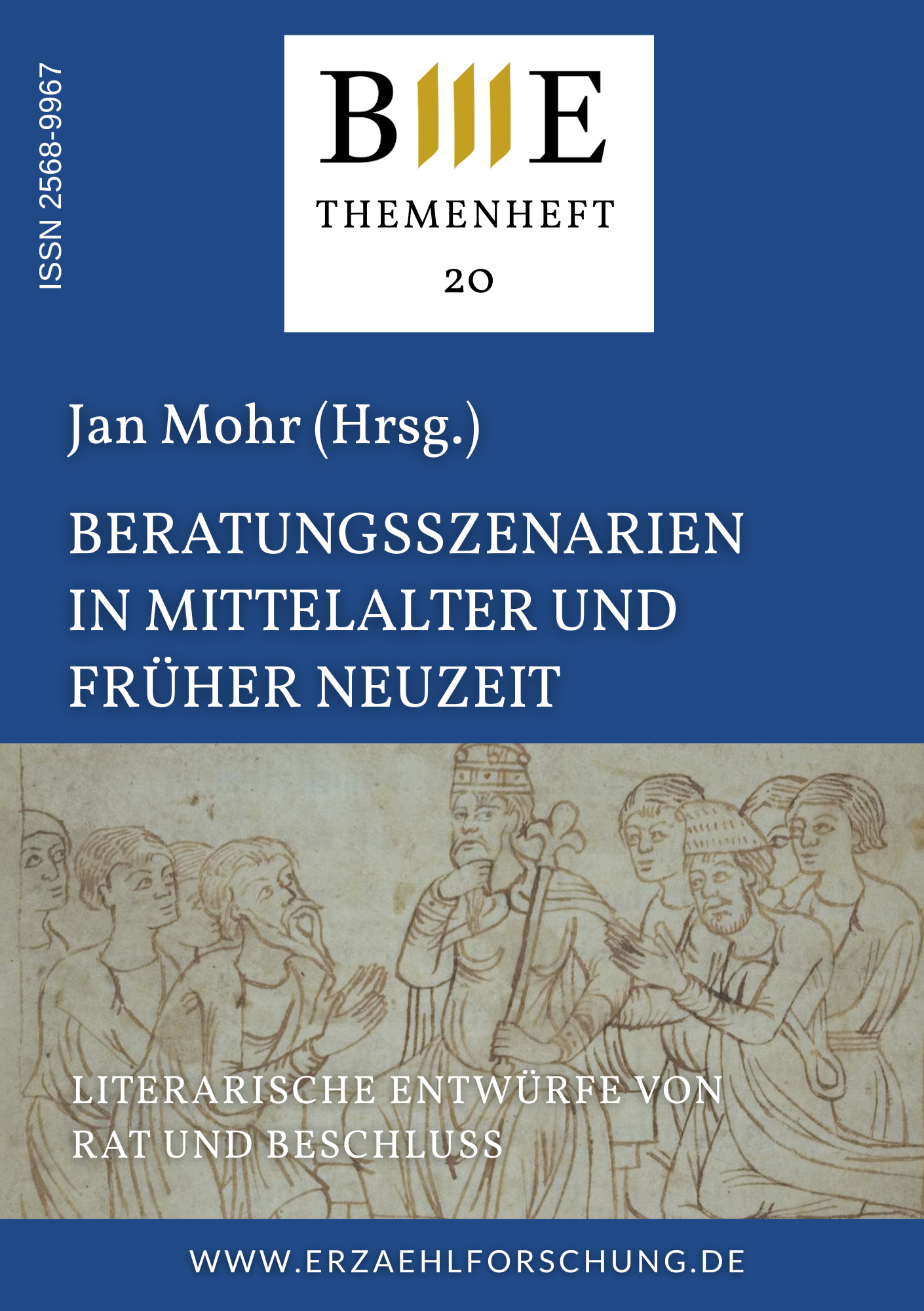
Advice, Counsel, and Wise Compromise: Deliberative Decision-Making in Chaucer’s ›Tale of Melibee‹, ›Wilhalm von Wenden‹ und ›Reinfried von Braunschweig‹ (deliberacion, billîch)
DOI:
https://doi.org/10.25619/BmE202620321Abstract
Late medieval literature highlights the importance of deliberative processes for the development of political consultation, decision-making, and a willingness to compromise. Chaucer’s ›Tale of Melibee‹ (›Canterbury Tales‹) can be read as a reference text to the contemporary idea of prudent, compromise-ready advising in the late Middle Ages (deliberacion). Likewise, deliberative consultation emerges in the courtly love, adventure, and legendary romances of the late 13th and early 14th centuries. In these works (e.g., ›Wilhalm von Wenden‹, ›Reinfried von Braunschweig‹), the virtue of prudentia forms an integral part of an ethics of counsel (Beratungsethik). The capacity to arrive at wise compromises encompasses essential ethical, emotional, and cognitive dimensions and is reflected, among other things, in an awareness of the situational appropriateness of decisions (billîch).
Downloads
Published
Issue
Section
License
Copyright (c) 2026 Christiane Witthöft

This work is licensed under a Creative Commons Attribution-NonCommercial-NoDerivatives 4.0 International License.