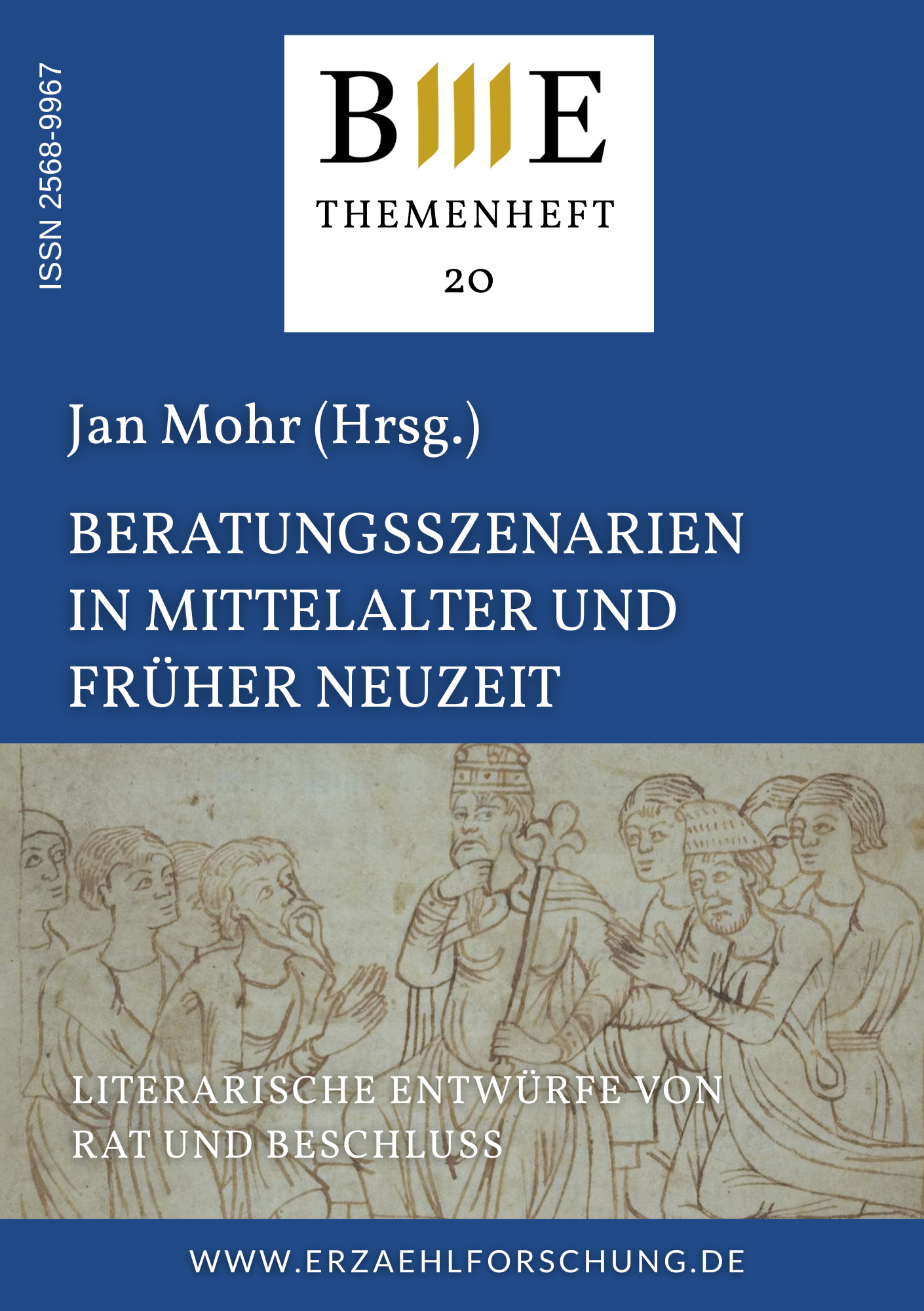
Giving Advice. The Uncertainty of Successful Communication in Medieval ›Didactic Dialogue‹ and ›Spruchsang‹
DOI:
https://doi.org/10.25619/BmE202620326Abstract
The essay examines the act of giving advice as a central social and communicative practice of the Middle Ages, using the example of literary forms of counsel in the Lehrgespräch and Spruchsang. It starts from the observation that political and didactic advice, grounded in the interactive structure of feudal advisory situations (consilium et auxilium), was always associated with a risk of failure, since the response of the advice-seeker could not be predicted. In narrative contexts such as the ›Nibelungenlied‹, it becomes clear that advice does not necessarily resolve conflicts but can instead intensify them. In the didactic poem ›Winsbecke‹, by contrast, advice appears largely risk-free, as it is based on a shared horizon of values. In Sangspruch poetry (Meister Sigeher and Frauenlob), the function of giving advice shifts: it serves less as a means of solving concrete problems and more as a vehicle for rhetorical persuasion and the poet’s self-presentation. Here, the success of the advice depends primarily on linguistic artistry, imagery, and strategic indirectness. The article demonstrates that literary advice-giving is shaped by a complex interplay of social function, the poet’s ethical claims, and his rhetorical staging. Its success is by no means guaranteed, as it depends on the situational context, power relations, and the performance of the advising poet.
Downloads
Published
Issue
Section
License
Copyright (c) 2026 Franziska Wenzel

This work is licensed under a Creative Commons Attribution-NonCommercial-NoDerivatives 4.0 International License.